Coalition against Dong Zhuo
The Romance of the Three KingdomsThe Coalition against Dong Zhuo is a temporary alliance of regional military leaders formed to oppose Dong Zhuo’s control of the Han court. Its members rally under the language of loyalty to the imperial family, but the coalition’s early military successes do not bring Dong Zhuo down: his forces retaliate against the capital, and the advance of the allied armies meets a landscape devastated by his retreat. The alliance’s story thus links a shared claim to political legitimacy with the limits and costs of coordinated military action.
Formation and stated purpose
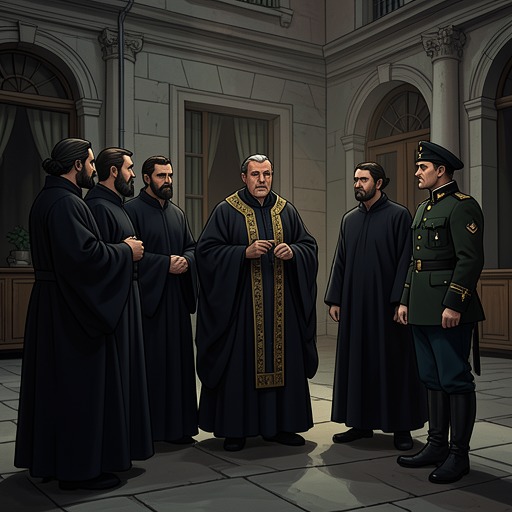
Cao Cao helps set the coalition in motion after gathering volunteers under a forged imperial edict. His force assembles beneath a white banner bearing the words “Loyalty” and “Integrity.” Copies of the edict reach Yuan Shao, who brings an army of thirty thousand to join him. Cao Cao then issues a proclamation urging other leaders to unite against Dong Zhuo, whom he accuses of crimes against the emperor, the palace, and ordinary people. Seventeen military leaders respond and head toward the capital.
The appeal gives the alliance a political purpose beyond defeating a rival army: its leaders present themselves as protectors of the imperial house and its shrines. Yuan Shao is chosen to lead the expedition. After sacrifices, he makes a vow before Heaven, Earth, and the ancestors that those assembled will defend the imperial family and its ancestral shrines from Dong Zhuo’s rule. His brother Yuan Shu receives responsibility for supplies, while Sun Jian offers to lead the advance toward the pass. These decisions give the coalition a leader, a logistical arrangement, and a forward force, though the evidence does not suggest that its members set aside their separate interests.
Members and early military encounters
Gongsun Zan joins the campaign with fifteen thousand men. On the way to the capital, he encounters Xuande, who has arrived as a local magistrate to pay his respects. Xuande and his sworn brothers are persuaded to join the uprising. Xuande says he would like the honor of killing Dong Zhuo; Zhang Fei recalls that he had previously been denied that opportunity, while Guan Yu urges the group to prepare and set out. Their arrival connects the coalition’s broad political undertaking with the fortunes of the Peach Orchard Brotherhood.
Sun Jian’s advance encounters Hua Xiong, whom Dong Zhuo dispatches with fifty thousand troops to block the opposing forces. Sun Jian is driven back, and his forces return to the main camp after heavy losses. At the ensuing council, Yuan Shao asks how to restore morale, but the commanders initially have no answer. Xuande is identified as a leader who defeated the Yellow Headband revolt and as a descendant of the imperial family; he is invited into the war council, with his two brothers-in-arms standing behind him.
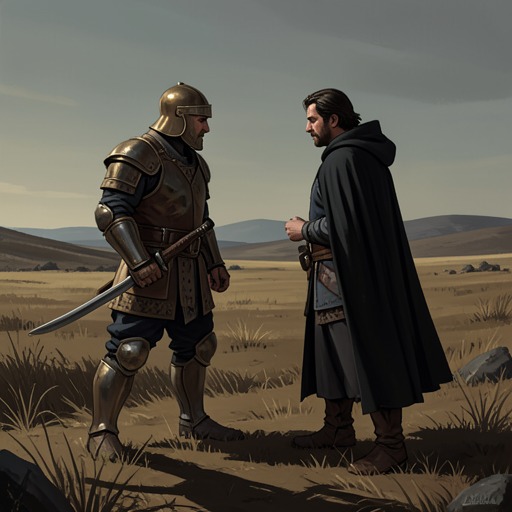
Hua Xiong then challenges the coalition’s warriors. Two champions are killed, leaving the council in despair. Guan Yu volunteers, but Yuan Shao dismisses him as merely an archer. Cao Cao argues that allowing him to try carries little risk. Guan Yu sets out before drinking the warmed rice wine Cao Cao has ordered for him. The episode makes a contrast between rank-based judgment and demonstrated ability, while turning the coalition’s crisis of morale into an opportunity for Guan Yu’s renown.
Dong Zhuo’s response and the alliance’s limits
The killing of Hua Xiong provokes a severe reprisal: Dong Zhuo orders the deaths of members of Yuan Shao’s family who are in the capital. He then sends two hundred thousand troops against the coalition and to guard Tiger Cage Pass, about fifty miles from Luoyang. There Lü Bu rides out against the allied forces, and successive challengers are defeated. Gongsun Zan is the sole champion described as escaping alive, pursued by Lü Bu before a timely intervention saves him. The campaign therefore shifts from the coalition’s success against Hua Xiong to a direct test against Dong Zhuo’s formidable forces and their leading warrior.
The conflict also reveals how little a shared declaration of purpose can protect civilians when power is exercised through reprisal and forced movement. Li Ru proposes taking the wealth of people in Luoyang associated with Yuan Shao. Five thousand troops are sent into the city; thousands of nobles, merchants, and members of their families are killed, and millions of inhabitants are driven toward Chang’an. Many die on the way, while the troops plunder. Dong Zhuo orders Luoyang burned, including its palaces and ancestral shrines, and the imperial tombs are opened and their treasures scattered.
Xuande, his sworn brothers, and their men eventually break through the pass as Sun Jian rides toward Luoyang. Their arrival does not restore the city or reverse its destruction: the account describes the surrounding country as emptied and desecrated. The contrast between the coalition’s vow to protect the imperial family and shrines and the ruin left by Dong Zhuo’s retreat gives its early campaign a stark result. It can gather leaders and armies under a common cause, but it cannot prevent the capital from becoming the immediate victim of the conflict.
Political significance
The alliance belongs to a wider collapse in which the Han empire fragments under warlords and competing leaders. Xuande, Cao Cao, and Sun Quan emerge as figures who eventually found separate dynasties, but the coalition episode precedes that settled division: it briefly brings different military powers together under a claim of loyalty to the old imperial order. Its members’ common enemy makes collective action possible, while the separate commands, supply arrangements, and competing warriors reveal the practical limits of unity.
The coalition’s political language also anticipates later arguments about who may rule and in whose name. Cao Cao’s appeal invokes the emperor and the protection of ordinary people; Yuan Shao’s vow makes the preservation of the imperial house the expedition’s declared charge. Yet the campaign’s immediate consequences include mass displacement and the burning of Luoyang, not restoration. In the narrative, the alliance is therefore both a response to Dong Zhuo’s seizure of authority and an early demonstration that invoking legitimate rule does not by itself secure either the court or the population it claims to defend.